
Delhi Police Bust ₹16 Crore Cyber Fraud Racket: Inside the Shell Company Job Scam
Delhi Police Bust ₹16 Crore Cyber Fraud Racket: Inside the Shell Company Job Scam
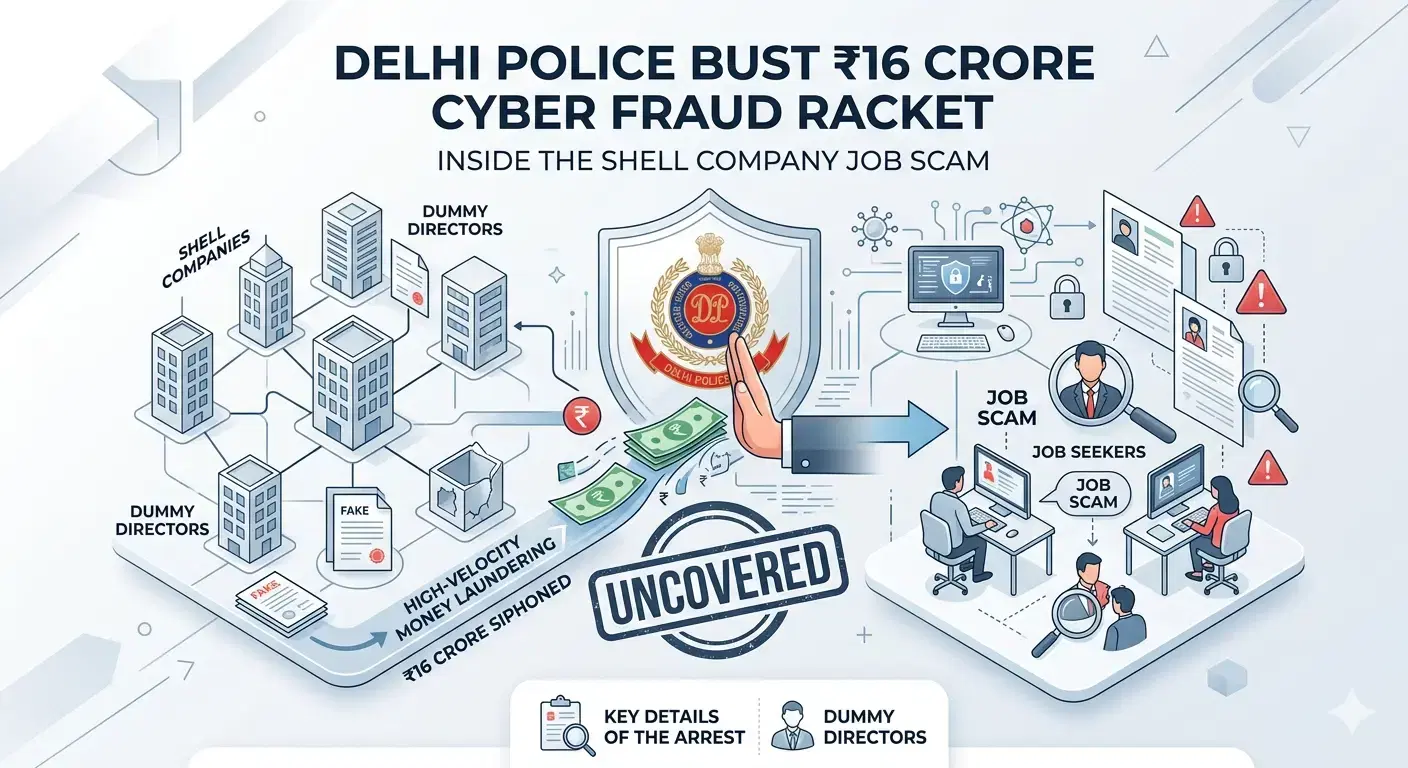
NEW DELHI — A high-velocity money laundering syndicate that siphoned ₹16 crore in just eight days has been decapitated by the Delhi Police. In a clinical strike against organized cybercrime, authorities dismantled a network that exploited unsuspecting job seekers and bank customers through a sophisticated web of shell companies and decentralized handlers.
Key Details of the Arrest: The "Dummy Directors"
The investigation reached a turning point on Friday with the arrest of two pivotal figures, Sonu Kumar and Aminder Singh. Identified as "dummy directors," the pair functioned as the public faces of a private limited firm that operated solely as a front for illicit activity. While the directors provided the legal veneer for the enterprise, investigators believe they were merely the ground-level facilitators for a much larger, hierarchical criminal syndicate.
The Money Trail: ₹16 Crore in 8 Days
The sheer efficiency of the laundering process underscores the clinical nature of this operation. The syndicate's financial logistics were built for speed and obfuscation:
- Transaction Velocity: The network funneled more than ₹16 crore through a single account in a staggering eight-day window.
- Collaborative Laundering: Forensic analysis revealed the account was operated by multiple users simultaneously, allowing for rapid-fire deposit and withdrawal of funds to stay ahead of banking red flags.
- The Bawana Outpost: The primary engine for these transactions was traced to a nationalised bank in Bawana, serving as the central hub for the movement of stolen capital.
Modus Operandi: How the Scam Functioned
The syndicate deployed a multi-stage trap designed to harvest proceeds from diverse victims before layering the money to vanish into the financial system:
- The Trap: Fraudsters targeted unsuspecting job seekers with fake employment opportunities and used deceptive tactics to initiate OTP-based frauds, draining the life savings of victims within minutes.
- Layering via Shell Companies: Once the proceeds were in, the money was diverted through a labyrinth of approximately 35 shell companies. This process of layering, moving funds across multiple entities and accounts, was designed to make the digital money trail nearly impossible for investigators to reconstruct.
Detection and Investigation: The Digital Footprint
The unravelling of this network began on the National Cyber Crime Reporting Portal, where a surge of suspicious activity flagged the Bawana-based account. The investigation revealed a massive footprint of exploitation:
- Cross-State Impact: The single bank account was tied to over 300 cyber fraud complaints spanning several states, proving the syndicate's national reach.
- Decentralized Hierarchy: While the dummy directors were apprehended in Delhi, police have confirmed that the handlers directing the operation are likely stationed outside the capital, managing the network's digital infrastructure from remote locations.
FAQ
Who were the individuals arrested in the Delhi job scam?
The Delhi Police arrested Sonu Kumar and Aminder Singh. The duo served as dummy directors for a shell company used to launder money obtained through job scams and OTP-based fraud.
How much money was involved in the Bawana shell company fraud?
The syndicate managed to route and siphon over ₹16 crore through a single bank account in Bawana in just eight days, utilizing rapid-fire transactions to evade detection.
How did Delhi Police identify the cyber fraud network?
The network was identified through the National Cyber Crime Reporting Portal after investigators linked more than 300 fraud complaints across multiple states to one specific bank account used by the shell company.
What is a dummy director in the context of this case?
A dummy director is a front-man who lends their name to a company's legal filings to facilitate money laundering. They provide a mask for handlers who operate the criminal enterprise from the shadows.
Conclusion and Current Status
The investigation remains active as Delhi Police work to identify the external handlers and dismantle the remaining cells of this wider syndicate. By intensifying the pursuit of digital money trails and scrutinizing the rapid movement of funds through shell entities, authorities aim to provide a more robust shield for job seekers and the national banking infrastructure against high-velocity cybercrime.