
Income Tax Refund Scam: How to Spot Fake Messages & Stay Safe
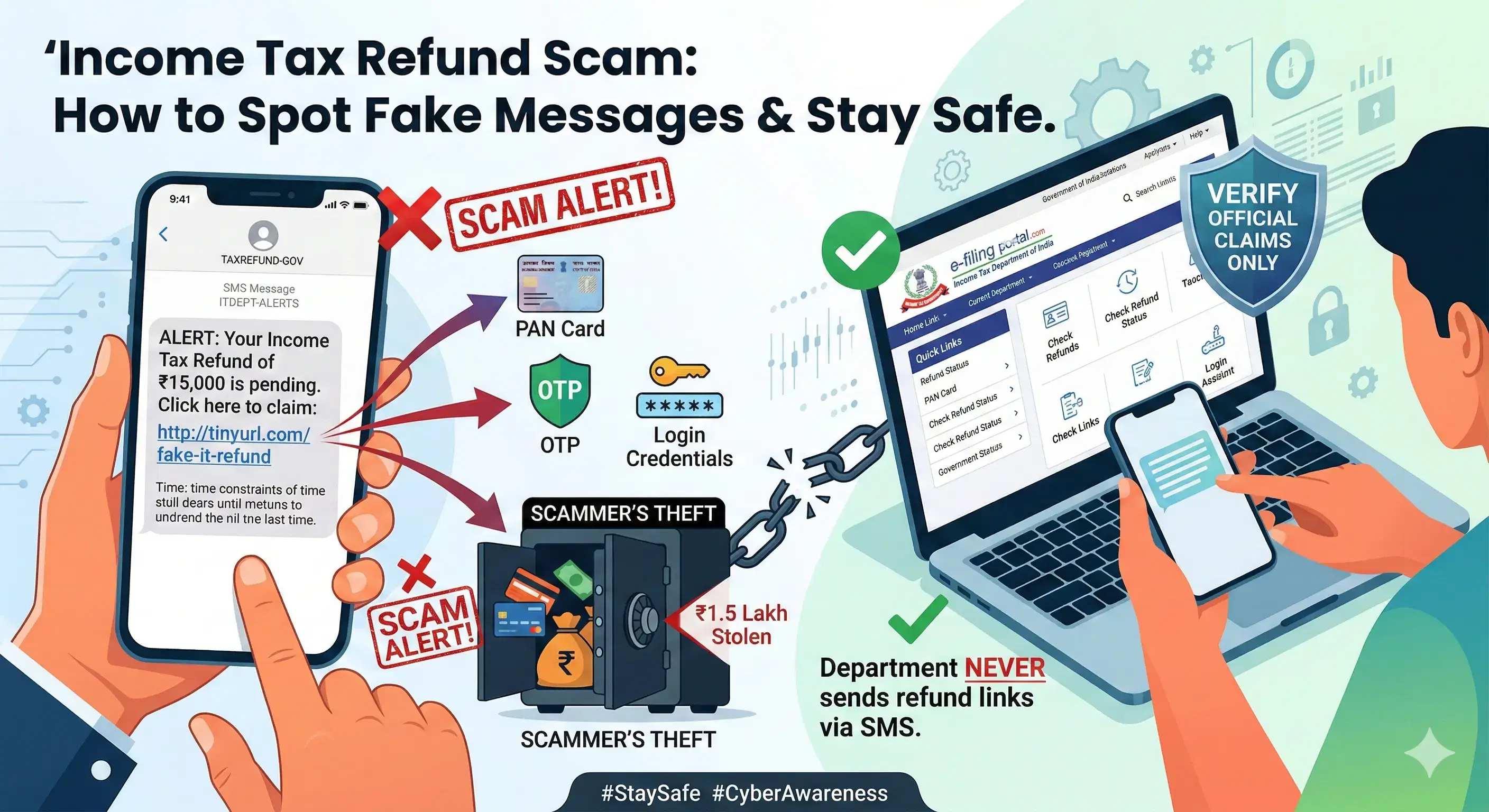
Income Tax Refund Scam: How to Spot Fake Messages & Stay Safe
1. Introduction: The Rising Threat of Refund Fraud
The Income Tax Department has issued an urgent warning following a devastating Income Tax Refund Scam where a taxpayer lost ₹1.5 lakh. This is not an isolated incident; it is a calculated strike by cyber-syndicates exploiting a climate of taxpayer anxiety.
Current intelligence for the 2024–2026 tax cycles indicates that scammers are actively monitoring social media platforms like 'X' (formerly Twitter). They identify taxpayers complaining about legitimate refund delays and target them with precision-engineered phishing messages. By masquerading as an immediate solution to these delays, fraudsters bait victims into compromising their life savings. Establishing the Income Tax Department as your only authoritative source is the first step in neutralizing this threat.
2. How the Income Tax Refund Scam Works: A Step-by-Step Breakdown
As highlighted by tax advisory platform TaxBuddy on 'X', the lifecycle of this scam is designed to mimic official government workflows to bypass your suspicion:
- The Initial Contact: You receive an urgent SMS claiming your income tax refund is "pending" or "delayed" and requires immediate verification.
- The Hook: The message provides a link that looks official at a glance, often using keywords like "refund-update" or "it-dept."
- The Fake Portal: Clicking the link redirects you to a fraudulent website. Always audit the URL — scammers use
.com,.org, or.netclones. The official government domain must end in.gov.in. Furthermore, check for the HTTPS padlock symbol; however, be aware that many sophisticated phishing sites now use SSL certificates to appear secure. - Data Theft: The fraudulent portal mandates that you enter your PAN, login ID, and password. To "finalize" the refund, it requests an OTP and, in many cases, your banking details.
- The Result: Armed with your login credentials and OTP, fraudsters gain full control of your account, intercepting your actual refund or draining your linked bank accounts.
3. Psychological Triggers: Why Taxpayers Fall for Phishing
Cybercriminals are masters of social engineering. They use specific psychological triggers to force "quick clicks" that lead to compromise:
- Fear-based Language: Using words like "action required," "non-compliance," or "account suspension."
- The "Final Reminder" Tone: Creating a false sense of scarcity to prevent you from verifying the claim.
- Threats of Refund Cancellation: Claiming your refund will "lapse" if you do not click the link immediately.
- Social Intelligence Exploitation: Targeting users who have publicly voiced frustration over delays on 'X', making the scam feel like a personalized response to their problem.
4. Official Policy: What the Income Tax Department Never Does
Use this Red Flag Checklist to audit any communication you receive regarding your taxes.
| Scammer Tactics | Official IT Department Policy |
|---|---|
| Sends refund verification links via SMS | Never sends refund links through SMS or WhatsApp |
| Requests OTPs via phone calls or SMS | Never asks for OTPs to "release" or "verify" a refund |
| Requests passwords via email/random links | Never requests login credentials through external links |
| Requires bank details via SMS links | Banking details are only updated via the secure e-filing portal |
5. The Truth About Refund Delays: Why Your Money is Actually Late
Understanding the legitimate government process is essential to maintaining your defense. While scammers exploit delays, the Income Tax Department maintains that legitimate wait times are usually due to:
- Due Verification: The system is performing rigorous checks on the submitted return.
- Data Matching: Ensuring your filed figures align with TDS data and other government records.
- Flagged Discrepancies: If a mismatch is detected, the return is moved to "scrutiny" or "pending verification," which naturally extends the timeline.
These are internal departmental processes. At no point do these legitimate delays require you to click a link in an SMS to move the process forward.
6. Protective Measures: How to Secure Your Tax Account
To protect your financial integrity, you must move from a reactive to a proactive security posture.
- Manually Audit the URL: Never click an embedded link. Manually type
https://www.incometax.gov.ininto your browser to access the official e-filing portal. - Intercept the Urgency: If a message pressures you to act, it is almost certainly a scam. Legitimate government notices are delivered via the secure portal dashboard.
- Mandate Credential Privacy: Never share your OTP, login ID, or password with anyone — even if they claim to be an "Income Tax Officer."
- Audit Your Status: Only trust the refund status displayed inside your official account on the e-filing portal.
- Report Fraud: Report all phishing attempts to the official IT Department grievance channels and the Indian Computer Emergency Response Team (CERT-In).
7. Frequently Asked Questions (FAQ) About Tax Refund Scams
Q1: How do I check my real refund status safely? Access the official e-filing portal directly at https://www.incometax.gov.in. Navigate to the 'Refund/Reissue' status under your profile dashboard.
Q2: Does the Income Tax Department send links via SMS? No. While they may send SMS alerts notifying you that a refund has been processed, they will never include a link to "click and claim" or "verify" the refund.
Q3: What should I do if I receive a message about a pending refund with a link? Do not click the link. Take a screenshot for reporting purposes and delete the message. Check your official portal account for any legitimate notices.
Q4: Who should I report phishing attempts to? You should report the incident to the official Income Tax grievance portal and the National Cyber Crime Reporting Portal (CERT-In).
Q5: Can a refund lapse if I don't click an SMS link? Absolutely not. Legitimate refunds are either credited to your pre-validated bank account or require action taken exclusively within the secure e-filing portal.
8. Conclusion: Vigilance is Your Strongest Defense
A delay in your tax refund is a procedural matter, not an emergency. Scammers rely on your desire for a quick resolution to bypass your better judgment. Remember: the Income Tax Department will never text you a link to your money. By relying solely on the official portal and treating every unsolicited SMS link with extreme suspicion, you can ensure your hard-earned money stays where it belongs — in your account.