
Interstate Investment Scam Busted: How Fraudsters Use Fake Trading Apps to Siphon Millions
Interstate Investment Scam Busted: How Fraudsters Use Fake Trading Apps to Siphon Millions
Executive Summary: The Rise of App-Based Stock Market Fraud
Law enforcement agencies have successfully dismantled a sophisticated interstate syndicate operating across Haryana, Punjab, and Madhya Pradesh, highlighting a dangerous evolution in digital financial crime. This operation involved the apprehension of two key operatives, including a former deputy assistant manager and sales officer of a bank, who utilized deep industry knowledge to facilitate professional-grade money laundering.
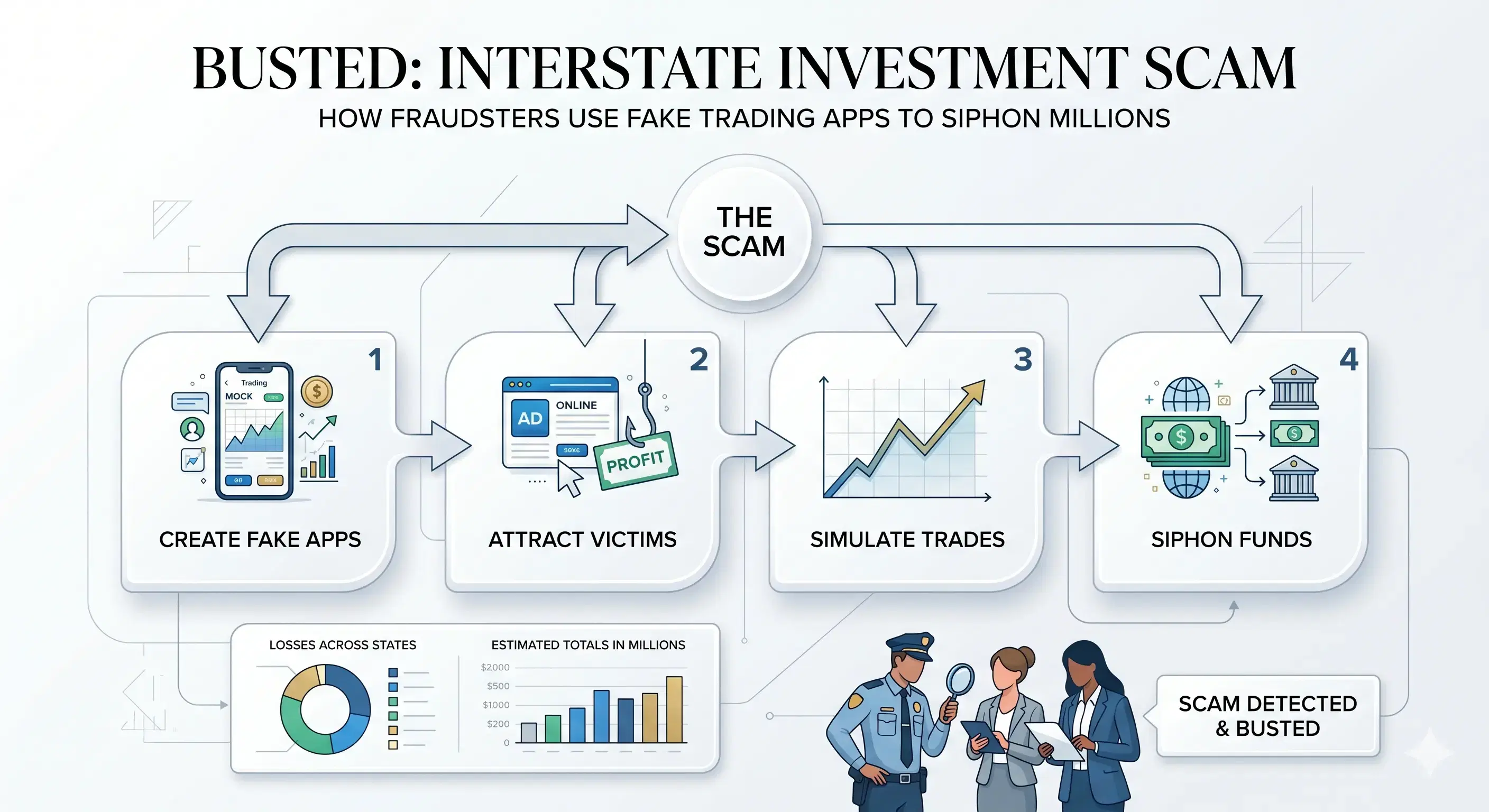
A Fake Stock Market Investment Scam is a fraudulent scheme where criminals pose as legitimate financial advisors to lure victims into downloading non-verified trading applications. These apps utilize a fraudulent UI/UX to display simulated, astronomical profits that encourage further capital injection, ultimately preventing any withdrawals unless the victim pays non-existent "fees" or "taxes." In this recent case, a victim from the Mahendergarh district was defrauded of significant capital, with investigators employing advanced financial forensics to trace the illicit flow of funds through a complex web of shell companies.
The Anatomy of the Scam: A Rs 14.26 Lakh Case Study
Between December 2025 and March 2026, a resident of Jhuk village in the Mahendergarh district was systematically targeted and defrauded of Rs 14.26 lakh. This Stock Market Fraud relied on psychological manipulation and a highly polished digital interface to maintain the illusion of institutional legitimacy.
Phases of the Fraud
- Initial Contact: Perpetrators initiated contact via WhatsApp, posing as senior representatives of a reputable financial services firm.
- App Installation: The victim was persuaded to download a Fake Trading App specifically designed to mimic real-time market movements and portfolio growth.
- Fabricated Profits: To build trust and exploit investor greed, the application displayed a deceptive account balance exceeding Rs 33 crore.
- The Exit Barrier: When the victim attempted to access the capital, the syndicate transitioned from "investment" to extortion, demanding a massive "tax clearance" fee.
The "10% Tax Clearance" Trap: A Critical Red Flag
The turning point in this Investment Scam occurred when the victim attempted to withdraw his supposed multi-crore gains. The syndicate demanded an additional Rs 3.34 crore, claiming it was a "10% tax clearance" required by regulatory authorities.
From an investigative perspective, this demand is the definitive hallmark of an Interstate Syndicate. Legitimate brokerage firms and trading platforms never demand upfront tax payments before processing a withdrawal. In standard financial ecosystems, taxes (such as Capital Gains Tax) are handled through official government filings or withheld at the source, but never as a separate, upfront "unlock fee" paid directly to the broker.
WARNING: If an investment platform requires you to pay a "tax fee," "activation fee," or "clearance charge" before you can withdraw your own money, you are being targeted by Cyber Fraud. Genuine financial institutions do not operate under this extortion-based model.
Behind the Syndicate: Money Laundering and Shell Companies
The syndicate's success relied on the technical expertise of a former banking professional and a laundering network handler. By combining insider banking knowledge with criminal intent, the group effectively bypassed traditional security measures.
The "Ex-Banker" Methodology
The former deputy assistant manager played a pivotal role in creating the infrastructure for the scam. His contributions allowed the syndicate to clear KYC hurdles that typically stop criminal entities:
- Shell Firm Creation: Using forged signatures and fabricated rent agreements to establish corporate entities.
- Institutional Facilitation: Setting up legitimate-looking business accounts to facilitate seamless online banking and fund routing.
- Communication Security: The illegal procurement of SIM cards to manage fraudulent accounts and communicate with victims anonymously.
The Scale of Operation
The investigation revealed a high-frequency laundering operation designed to move siphoned funds across state lines rapidly. Using financial forensics, cyber experts traced nearly Rs 6.33 lakh of the victim's money specifically to a bank account linked with a Shell Firm in Gwalior. This specific account was already flagged in eight separate national Cyber Fraud complaints and a separate Rs 96 lakh cheating case lodged in Delhi.
Police Action and Evidence Recovery
Following an intensive probe by cyber experts, coordinated raids were conducted in Faridkot (Punjab) and Gwalior (Madhya Pradesh), leading to the apprehension of the primary operatives.
Evidence Seized in Syndicate Bust
| Category | Items Recovered |
|---|---|
| Financial Instruments | 15 Cheque books, 6 ATM cards, 7 Bank passbooks |
| Liquid Assets | Rs 1.25 Lakh in Cash |
| Communication Gear | 4 Mobile phones, Multiple illegally procured SIM cards |
| Documentation | Forged rent agreements, Forged signature documents |
People Also Ask: Investment Scam FAQ
How can I tell if a trading app is fake?
Fake trading apps often share common characteristics: they are promoted through unsolicited WhatsApp or Telegram messages rather than official app stores, and they display "guaranteed" high returns. If the app shows massive profits—such as the Rs 33 crore illusion used by this Interstate Syndicate—that seem disproportionate to your investment, it is a fraudulent interface.
Do legitimate brokers ask for tax payments to withdraw funds?
No. Legitimate brokers do not require an upfront "tax clearance" payment to release your funds. Any demand for a 10% fee (or any percentage) as a prerequisite for withdrawal is a definitive indicator of Stock Market Fraud.
What should I do if I am a victim of a stock market scam?
Immediate action is vital. Report the incident to your local cybercrime cell or via the national cyber fraud portal. As seen in this case, cyber experts can trace the money trail to a Shell Firm and help police freeze accounts or conduct raids to recover evidence.
Conclusion: Protecting Your Portfolio in the Digital Age
The bust of this interstate syndicate serves as a stark reminder that modern financial fraudsters are no longer just "hackers"—they are former industry professionals who understand how to manipulate banking systems and investor psychology.
Protecting your portfolio requires extreme vigilance. Always verify the credentials of any financial service firm through official regulatory bodies and avoid all investment advice originating from unsolicited WhatsApp messages. While the sophisticated use of shell firms and forged documents makes these scams difficult to spot, the "tax clearance" demand remains a definitive red flag that can save investors from losing millions to Cyber Fraud.