
The Parcel You Never Ordered: The Dangerous New Scam Hiding in Your Delivery Notifications
The Parcel You Never Ordered: The Dangerous New Scam Hiding in Your Delivery Notifications
The convenience of modern logistics has transformed our daily lives into a series of seamless transactions. From morning milk and groceries to the latest electronics and household essentials, the arrival of a delivery person has become a routine, almost invisible part of our household rhythm. We have been conditioned to expect packages at all hours, turning our doorsteps into the final link of a global supply chain.
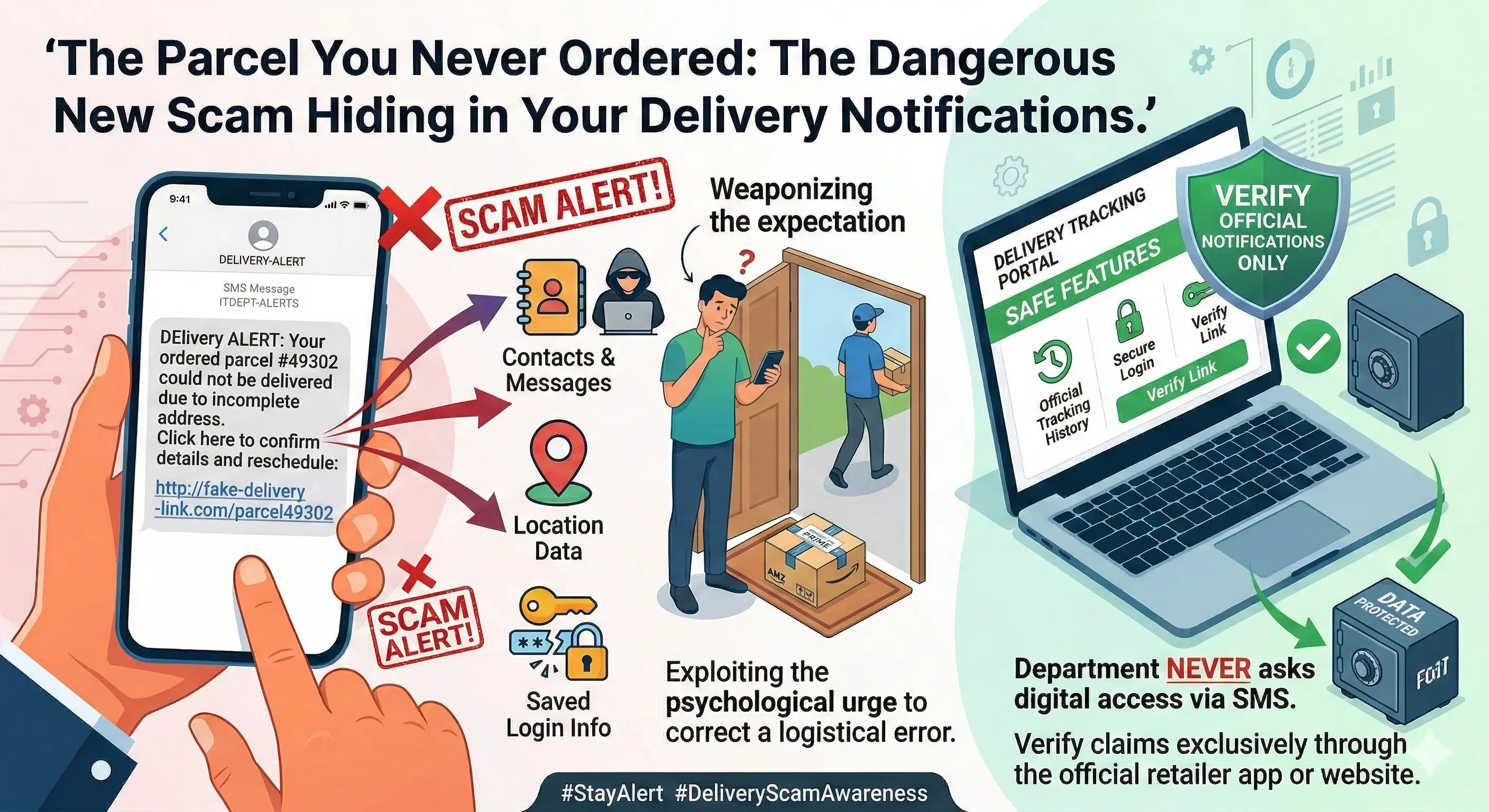
However, this very habit — our expectation of constant delivery — is being weaponized by cybercriminals. A new scam is currently circulating that bypasses sophisticated digital firewalls by using a remarkably simple tool: a knock at the door or a standard SMS. By exploiting the psychological urge to correct a logistical error, fraudsters are gaining full access to victims' digital lives.
The Counter-Intuitive 'Cancellation' Trap
The core mechanic of this fraud relies on a perceived error. A fraudster, often posing as a delivery agent, contacts a resident claiming that a parcel has been 'mistakenly' booked to their address. Because the victim knows they did not place the order, their natural instinct is to rectify the situation to avoid being charged or receiving unwanted goods.
The scammer then offers a seemingly helpful solution: they will 'cancel' the delivery on the spot. To finalize this, they claim the victim must provide a One-Time Password (OTP) sent via SMS or click a phishing link provided in a message. This is the moment the 'high-tech' security we rely on is bypassed. By sharing that OTP, you aren't canceling a package; you are authorizing a device registration or a large UPI transaction. The OTP is the keys to the kingdom, and the scammer is simply asking you to unlock the door.
The Telangana State Police have issued a clear directive on this interaction:
"If someone comes to your house claiming to deliver a parcel you did not order, treat it as a cyber fraud attempt."
Physical Security Breaches and Device Access
In a more aggressive variation of this tactic, scammers do not just call or text; they visit the victim's home in person. Once there, they may claim there is a technical issue and ask to 'check' the cancellation message on the victim's phone directly.
Handing over a mobile device to a stranger, even for a few seconds, represents a total security failure. From a strategist's perspective, this allows for Session Hijacking and Identity Theft. Once a criminal has physical possession of an unlocked phone, they can bypass biometric security to access private photos, videos, and, most critically, banking applications that are already logged in.
Warning: Never hand over your mobile device to a stranger or delivery agent for any reason. Legitimate delivery services will never require physical access to your phone to process a cancellation or verification.
Escalation to 'Legal' Extortion
What begins as a simple delivery error can rapidly escalate into psychological warfare. This is a deliberate social engineering pivot: the scammer switches from being a 'helpful agent' to an 'authority figure' designed to paralyze the victim's critical thinking. They may claim that the intercepted parcel contains illegal contraband, such as drugs or explosive substances.
By shifting the tone from a logistical mistake to a potential legal catastrophe, the fraudsters aim to induce panic. They then demand immediate payment to 'settle' the matter and avoid involvement with law enforcement. This transition is a high-pressure tactic used to bypass rational thought through the immediate threat of criminal charges.
The ₹7.12 Crore Reality Check
The financial stakes of these interactions are extraordinarily high. This is not a petty crime; it is a high-yield enterprise for cybercriminals. The Telangana Cyber Security Bureau recently highlighted a case involving an 81-year-old man who was targeted by a similar fraud.
After being threatened over the phone and manipulated by these deceptive tactics, the victim was cheated of ₹7.12 crore. This staggering loss serves as a grim reminder that these scams are not mere nuisances — they are sophisticated operations capable of causing total financial devastation to those who are caught off guard.
Exploiting the 'New Normal' of Logistics
Cybercriminals are successfully hiding their activities in the 'noise' of our daily routines. Because many households now receive daily deliveries of essentials like milk, groceries, and clothing, the arrival of a delivery agent no longer triggers the suspicion it once did. The 81-year-old victim's vulnerability likely began with a routine-looking interaction that escalated once the scammers established a foothold.
This 'new normal' requires a shift toward constant Cyber Vigilance. In an era where digital and physical worlds are inextricably linked, the doorstep has become a front line for digital security. We must treat an unexpected delivery person with the same caution we would apply to an unexpected login attempt on our bank account.
Summary: Protecting Your Digital Front Door
To protect yourself from parcel-related fraud, follow these actionable steps recommended by law enforcement:
- Refuse Unordered Packages: If you did not order it, do not accept it. Do not attempt to 'cancel' it via a third party at your door.
- Protect Your OTP: Never share a One-Time Password with anyone, especially someone claiming it is for a cancellation.
- Maintain Device Control: Never hand your phone to a delivery person or stranger to prevent session hijacking.
- Report Immediately: If you believe you are being targeted or have lost money, contact the Cyber Crime Helpline at 1930 immediately.
- File an Official Complaint: Use the official government portal at https://www.cybercrime.gov.in to report the incident.
In our rush for digital convenience, have we forgotten that the most secure password in the world is useless if we simply hand it over to a stranger at the door?