
UPI Fraud Trends in India 2026: A Comprehensive Guide to RBI Alerts, New Scams, and Protection Strategies
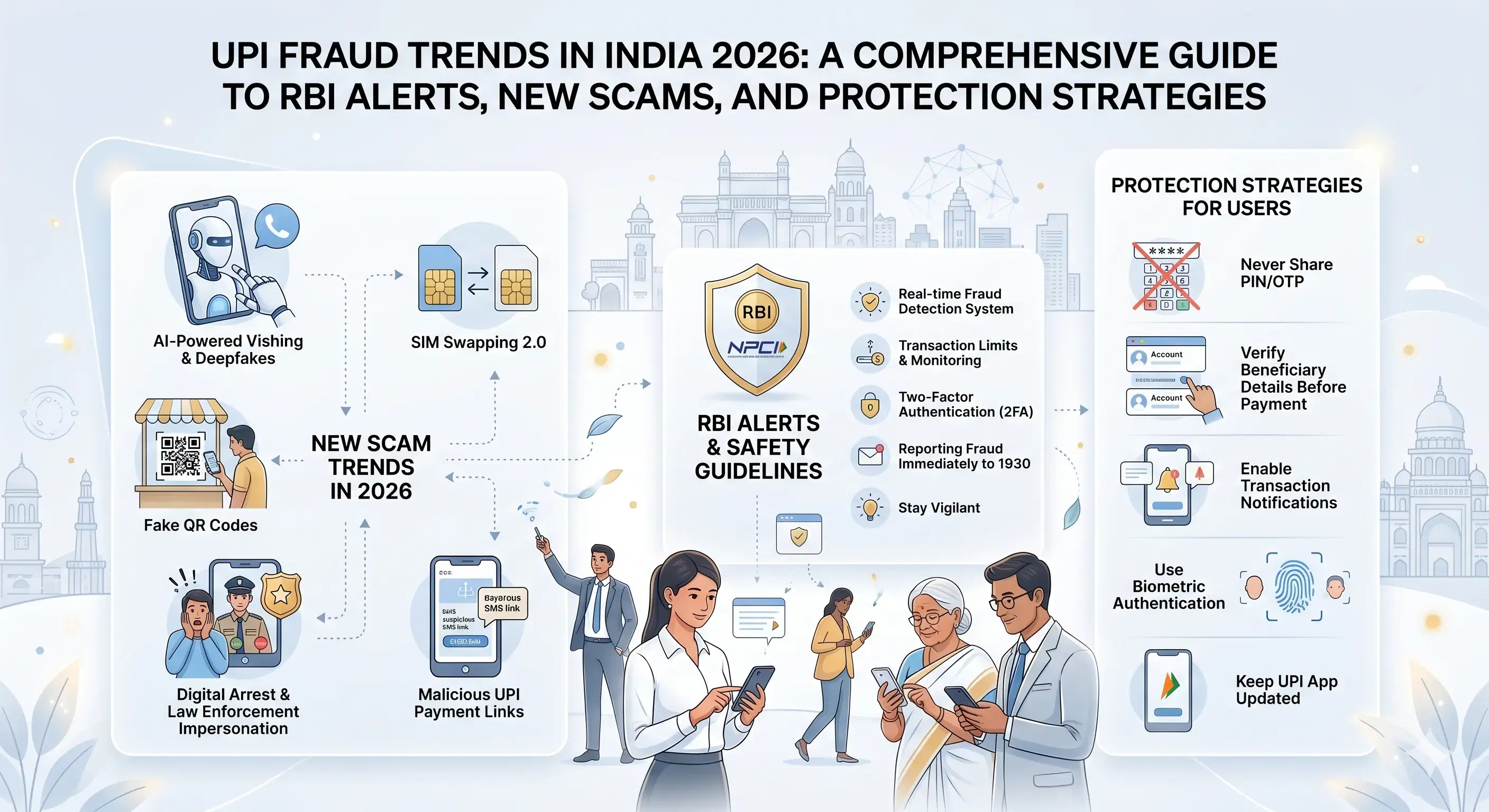
UPI Fraud Trends in India 2026: A Comprehensive Guide to RBI Alerts, New Scams, and Protection Strategies
1. The State of UPI in 2026: An Era of Scaled Risk
As we navigate the 2026 digital landscape, India's Unified Payments Interface (UPI) continues to define global fintech, processing a staggering 20 billion transactions monthly. However, this high-velocity environment has necessitated a shift in Financial Cyber Hygiene. The Reserve Bank of India (RBI) reports a 34% year-on-year increase in digital payment fraud, driven primarily by social engineering scripts rather than a technical compromise of the NPCI Security Stack.
Current UPI Fraud Trends in India 2026 highlight a sophisticated shift toward "Authorized but Unintended" (AbU) transactions. In an AbU scenario, the attacker exploits the human-to-interface vulnerability layer, manipulating the victim into providing the Second Factor of Authentication (2FA)—the UPI PIN. Because the victim voluntarily authorizes the transaction, automated banking safeguards initially view the transfer as legitimate, creating significant hurdles for the "Zero-Liability" recovery process.
Key Statistics: The Economic Impact of Fraud (FY24-FY26)
- Total Losses (FY24): Rs 1,087 crore across 13.42 lakh incidents.
- H1 FY25 Losses: Rs 485 crore (April-September 2024).
- Average Loss Range: Rs 12,000 to Rs 4.5 lakh per incident.
- FY26 Trajectory: Losses hit Rs 805 crore by November 2025, a projected increase compared to FY25's Rs 981 crore.
2. The Top 5 UPI Fraud Trends Flagged by the RBI
The RBI and NPCI have identified five dominant patterns of 2FA Circumvention currently targeting Indian consumers and businesses.
Trend 1: Fake UPI Collect Requests
- How it Works: Scammers send a "request money" (collect) notification disguised as a "cashback" or "advance payment." The victim, expecting a credit, enters their PIN, unwittingly authorizing a debit.
- Risk Level/Victim Profile: Very High. Targets OLX/marketplace sellers and small traders.
- RBI Alert Context: In Q1 2026, the RBI flagged 18 lakh such requests. NPCI now mandates a high-visibility red "YOU ARE PAYING" alert to disrupt this social engineering flow.
Trend 2: QR Code Swap at Merchant Terminals
- How it Works: Criminals physically overlay a fraudulent QR code onto a merchant's legitimate static QR. Funds intended for the business are diverted to a scammer-controlled account.
- Risk Level/Victim Profile: High. Common at high-traffic points like fuel stations and retail kiosks.
- RBI Alert Context: Per circular DPSS.CO.PD 2025-26, merchants are now required to perform daily physical verification of their QR hardware.
Trend 3: Screen-Share OTP Theft
- How it Works: Attackers pose as technical support, convincing victims to install remote access tools (AnyDesk, TeamViewer) to "unblock" an account. This allows the scammer to capture OTPs and observe the UPI PIN entry in real-time.
- Risk Level/Victim Profile: Critical. Generally triggered by "Account Blocked" SMS phishing.
- RBI Alert Context: March 2026 NPCI advisories emphasize that no financial institution will ever request remote device access.
Trend 4: Fake Customer Care Phishing Links
- How it Works: Scammers use SEO manipulation to display fake helpline numbers on search engines. When contacted, they send a link or a Rs 1 "verification request" that initiates a high-value debit.
- Risk Level/Victim Profile: High. Targets users seeking assistance for failed transactions.
- RBI Alert Context: I4C reported the removal of 4,200 fraudulent customer care pages in Q2 2026.
Trend 5: SIM Swap-Triggered UPI Takeover
- How it Works: Using breached KYC data, scammers obtain a duplicate SIM to intercept OTPs and reset UPI credentials, effectively bypassing device-binding security.
- Risk Level/Victim Profile: Extreme. Targets high-balance accounts with losses exceeding Rs 25 lakh.
- RBI Alert Context: A mandatory 5-day cooling period (no UPI transactions) is now implemented for accounts with a daily limit >Rs 50,000 following a SIM swap.
3. Social Engineering: How Scammers "Hack the Human"
Scammers follow a systematic Digital Payment Security breach protocol to bypass technical barriers:
- Target Selection: Harvesting data from marketplaces, social media, or leaked KYC databases.
- Impersonation: Utilizing "Social Engineering Scripts" to pose as bank officials or trusted buyers.
- Psychological Trigger: Using Urgency/Fear to bypass critical thinking or Greed/Relief to incentivize fast action.
- Trigger Action: Sending a malicious link, swapped QR, or collect request.
- Authorization: Tricking the victim into providing the 2FA (PIN/OTP).
- Mule Account Layering: Funds are moved through multiple layers of "mule accounts" within minutes to complicate tracing.
Quick-Scan Reference: Red Flags
| Red Flag | Scenario / Psychological Trigger |
|---|---|
| PIN for Receiving | Greed/Relief: Being told you must enter a PIN to "accept" a refund or prize. |
| Remote Access Request | Authority: A "bank officer" requiring AnyDesk or TeamViewer for "verification." |
| Urgent Account Blocking | Urgency/Fear: Threats to freeze your bank account unless you click a link immediately. |
| Screenshot Over-Reliance | Authority: A buyer pressuring you to accept a doctored screenshot as proof of payment. |
| Unsolicited Verification | Fear: Receiving a Rs 1 request to "verify" your account for NPCI compliance. |
4. Real-World Impact: 10 Case Studies of UPI Fraud (2025-2026)
| Victim Profile | Fraud Type | Amount Lost | Recovery Outcome | Security Gap / Key Takeaway |
|---|---|---|---|---|
| Delhi Kirana Shop Owner | QR Code Swap | Rs 3.2L | 15% via FIR | Failure to verify merchant name on display. |
| Kolkata Landlord | Fake Collect Request | Rs 45,000 | Full (Reported <30 mins) | Reporting within the "Golden Hour" saved funds. |
| Mumbai Freelancer | Screen-Share OTP | Rs 4.1L | Nil | Granted remote access to a "Support Agent." |
| Bengaluru HR Professional | Fake Customer Care | Rs 1.8L | Nil | Micro-transactions evaded real-time detection. |
| Pune OLX Bike Seller | Fake Advance Collect | Rs 12,000 | Full (Dispute) | Immediate use of BHIM dispute mechanism. |
| Hyderabad Trader | SIM Swap Takeover | Rs 14L | 8% via I4C | Lack of SIM-change alerts/secondary number. |
| Chennai Retired Teacher | NPCI Impersonation | Rs 67,000 | Nil | Entered PIN on a phishing link site. |
| Jaipur Medical Shop | QR Code Swap | Rs 1.9L | Nil | Small, fragmented payments delayed detection. |
| Gurgaon Startup Founder | Screen-Share (GPay) | Rs 8.7L | Nil | International transfer layering blocked recovery. |
| Lucknow Gig Worker | Fake Task Platform | Rs 23,000 | Nil | Victim bypassed 2FA for "investment" payout. |
5. The Geography and Data of Fraud
Fraud distribution remains heavily concentrated in high-adoption hubs:
- Maharashtra: 25% of cases.
- Karnataka: 18% of cases.
- Delhi-NCR: 15% of cases.
- South India: Represents 40% of national reports, indicating higher awareness and reporting rates.
Refund Eligibility (RBI Zero-Liability Framework)
| Reporting Window | Eligibility Criteria | Outcome / Liability |
|---|---|---|
| <= 3 Working Days | Third-party Breach: No victim negligence (e.g., system hack). | Full Refund (Zero Liability) |
| 3-7 Working Days | Partial Negligence: Delay in reporting or unintentional detail sharing. | Capped Refund (Rs 5k - Rs 25k liability) |
| > 7 Working Days | Victim Negligence: Shared PIN/OTP or delayed reporting. | No Auto-Refund; requires FIR/Legal action. |
6. Actionable Prevention Strategy: Ranked by Effectiveness
| Prevention Method | Effectiveness | Effort Required |
|---|---|---|
| Block remote access app requests | Critical | Zero |
| Set daily transaction limits (e.g., Rs 5,000) | Very High | Low (One-time) |
| Decline unknown "Collect" requests | Very High | Minimal Awareness |
| Register on Sanchar Saathi (SIM alerts) | High | One-time Setup |
| Use UPI Lite for small/daily payments | High | Low |
| Physical verification of Merchant QR | High | 30 Seconds |
7. The Merchant and Gig Worker Safety Protocol
Business owners and freelancers must adopt these Non-Negotiable Habits:
PRO-TIP: Verify via Bank App Only Never trust a "Payment Successful" screenshot or SMS. In 2026, "Fake Screenshot" apps are a primary tool for fraudsters. Always verify the credit via your actual bank statement or the "Transactions" tab in your UPI app before completing a sale.
- Audit Physical QRs: Inspect stickers daily to ensure they haven't been swapped.
- Internal Reconciliation: Reconcile UPI settlements against your order log every 24 hours.
- No PIN for Credits: As a seller, you never need to enter a PIN to receive a payment.
- Biometric Hardening: Enable biometric-only authentication for all collection devices.
8. Immediate Response: The "Golden Hour" Checklist
If you are victimized, the first 60 minutes are critical for freezing funds before they are moved through mule account layers.
- Call 1930 Immediately: This connects you to the National Cybercrime Helpline for real-time account freezing via the I4C portal.
- Report to cybercrime.gov.in: Provide transaction IDs and screenshots immediately.
- NPCI Resolution: Call the official NPCI complaint line at 1800-120-1740.
- Bank Notification: Freeze your UPI access and request a "Fraudulent Transaction Dispute."
- RBI Ombudsman: If the bank fails to provide a resolution within 30 days, escalate via cms.rbi.org.in.
9. Future Outlook: AI, ML, and New Security Mandates
The NPCI Security Stack is evolving to counter emerging 2026 threats:
- Micro-transaction Fraud: Scammers are using dozens of small (<Rs 500) transfers to stay under the radar of traditional fraud detection; AI scoring now flags these patterns.
- Deepfake Voice Phishing: Attackers use AI to impersonate relatives in distress. Always verify such requests via a secondary communication channel.
- Biometric Mandates: The RBI now requires biometric authentication for transactions over Rs 10,000 and is proposing re-authentication for any transfer exceeding Rs 50,000.
10. Frequently Asked Questions (FAQ)
What are the top UPI fraud trends in India in 2026?
The top 5 are: fake collect requests, QR code swaps at merchant points, screen-share OTP theft, fake customer care UPI links, and SIM swap-triggered account takeovers. RBI has issued specific advisories on all five in 2025-26.
What are the latest RBI alerts on UPI fraud?
RBI's key 2025-26 measures include: 4-hour cooling period for new UPI payees, mandatory 'YOU ARE PAYING' alert on collect requests, and proposed re-authentication for transactions above Rs 50,000.
How does QR code fraud work at merchant points?
Fraudsters physically replace or cover a merchant's QR code with their own. Customers scan and pay - funds go to the fraudster, not the merchant. Merchants discover the fraud only when customers complain about non-receipt.
What is the average loss in UPI fraud cases?
Average losses range from Rs 12,000 for collect request scams to Rs 14+ lakh for SIM swap UPI takeovers. Screen-share fraud averages Rs 80,000-4.5 lakh. Corporate account fraud can run into crores.
What apps help prevent UPI fraud?
TRAI's Sanchar Saathi (SIM swap alerts), Truecaller (caller ID for known fraud numbers), and your bank's own UPI fraud alert settings are the most effective. Avoid third-party 'UPI protection' apps from unknown developers.
11. Conclusion and Call to Action
The technical integrity of UPI is world-class; however, scammers continue to exploit the human-to-interface vulnerability layer. By adhering to two strategic rules-never enter a PIN to receive money and never grant remote access to your device-you eliminate 80% of current fraud risks.
Stay vigilant and prioritize your Financial Cyber Hygiene. Awareness is the ultimate firewall.
Report all UPI fraud at cybercrime.gov.in or call the 1930 National Cybercrime Helpline immediately.