
Identifying and avoiding the "Stock Market Trap": A Case Study in Investment Fraud
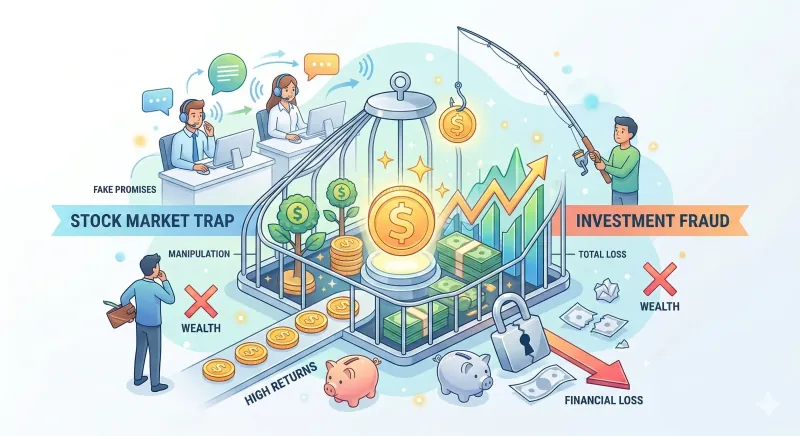
Investment scams continue to evolve in sophistication, often disguising themselves as legitimate financial advisory services. One such scheme, commonly referred to as a "Stock Market Trap," uses fake call centers, fabricated credentials, and promises of guaranteed returns to convince investors to transfer money. A recent cybercrime investigation in Bengaluru exposed how these organized operations exploit trust and financial ambition to steal large sums from victims across the country.
What Is a Stock Market Trap?
A stock market trap is a form of investment fraud where scammers pose as financial advisors, portfolio managers, or investment firms. Using professional branding, persuasive communication, and false promises of high returns, they convince investors to transfer funds into accounts controlled by the fraudsters. Once the money is received, communication is terminated and the victims are left with significant financial losses.
Case Study: The Bengaluru Fake Call Center Operation
The Central Division Cyber Crime Police dismantled a large-scale stock market fraud operation in Bengaluru that operated under the name Multiwave Business Solutions Private Limited. The organization maintained a physical office and presented itself as a legitimate financial consultancy. The setup was carefully designed to gain credibility and attract investors from across India.
31 Mobile Phones: Used for contacting and following up with potential victims.
13 Laptops: Used to manage victim information and coordinate fraudulent activities.
16 SIM Cards: Used to conceal identities and avoid detection.
Company Letterheads: Created a false appearance of legitimacy.
Victim Data Sheets: Contained names and contact details of potential targets sourced from investment-related databases.
Anatomy of the Fraud: How the Trap Functions
Investigators found that the fraud followed a structured process designed to build trust before extracting money from victims.
1. Data Sourcing
The fraudsters collected information about stock market participants from online sources, lead providers, and compromised databases. This allowed them to target people already interested in investing.
2. The Hook (Social Engineering)
A team of customer care executives contacted potential victims while pretending to be relationship managers or market analysts. They used stock market terminology, promises of exceptional returns, and repeated communication to build trust and establish credibility.
3. The Infrastructure of Deception
The operation relied on fake company branding, forged documents, rented office space, and SIM cards obtained through third parties. Together, these elements created the appearance of a legitimate financial services company.
4. The Transaction Phase
Once trust was established, victims were persuaded to transfer funds into accounts controlled by the syndicate. The transfers were presented as investment opportunities, portfolio allocations, or special trading schemes. Victims were often pressured to act quickly to avoid missing a supposedly profitable opportunity.
5. The Exit and Disappearance
After receiving the money, the fraudsters disconnected communication channels, discarded SIM cards, and withdrew funds through various accounts. The money was then distributed among members of the group, making recovery more difficult.
The Role of Mule Accounts and Identity Theft
A key component of investment fraud is the use of mule accounts. These accounts help criminals move and disguise stolen funds by routing money through multiple accounts before withdrawing it. Fraudsters also misuse stolen identities to obtain SIM cards and banking access, creating additional barriers for investigators attempting to trace the operation. Physical cash withdrawals further reduce the visibility of the financial trail.
Red Flags: How to Spot a Stock Market Trap
Recognizing warning signs early can help investors avoid becoming victims.
Unsolicited Investment Calls: Receiving investment advice from firms you never contacted.
Guaranteed High Returns: Claims of assured, risk-free, or guaranteed profits.
Pressure to Transfer Funds Quickly: Requests for immediate payments to avoid missing an opportunity.
Unverifiable Credentials: Difficulty confirming registrations, licenses, or company details.
Lack of a Transparent Physical Presence: Offices, addresses, or business information that cannot be independently verified.
If you encounter multiple warning signs, stop all communication and verify the organization through official regulatory channels before making any investment decisions.
Frequently Asked Questions (FAQ)
What should I do if I am a victim of a stock market investment scam?
Report the incident immediately to your local Cyber Crime Police unit. Provide transaction records, bank account details, phone numbers, emails, chat histories, and any evidence related to the fraud. Quick reporting increases the chances of freezing funds and supporting an investigation.
How do fake call centers operate in the stock market?
Fake call centers operate like legitimate telemarketing firms. They recruit staff, provide scripts, and use professional communication techniques to convince investors that they represent genuine advisory services. Their goal is to persuade victims to transfer money under the guise of investment opportunities.
Are stock market traps traceable?
Yes. Law enforcement agencies use digital forensics, mobile tracking, banking investigations, and inter-agency coordination to trace these operations. Although criminals attempt to hide behind fake identities and mule accounts, many organized fraud networks have been successfully dismantled through coordinated investigations.
Conclusion: Protecting Your Portfolio
The stock market trap is a sophisticated form of financial fraud that combines social engineering, fake corporate identities, and technical deception to exploit investors. While cybercrime units continue to investigate and dismantle such operations, the most effective protection remains awareness and caution. Always verify financial advisors, confirm regulatory registrations, research companies independently, and remain skeptical of unsolicited investment opportunities that promise unusually high returns.
Key Takeaway: Never invest based solely on a phone call, unsolicited message, or promise of guaranteed profits. Independent verification and careful due diligence remain your strongest defenses against investment fraud.