
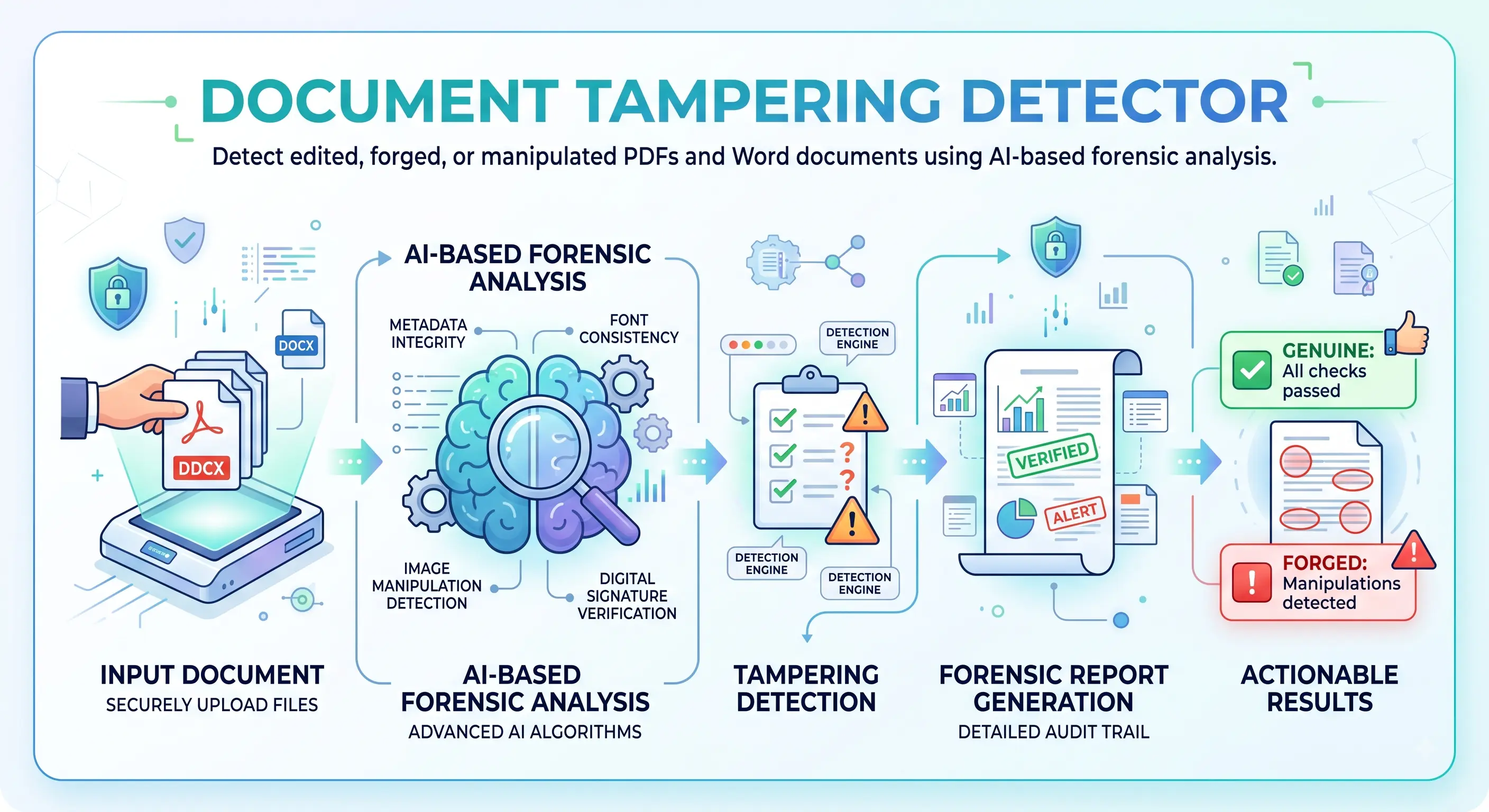
Document Tampering Detector
DocGuard AI Forensics helps organizations verify the authenticity of PDF and Word documents by analyzing their internal structure, metadata, and content layers for signs of manipulation. Using AI-driven forensic scanning, it detects altered text, forged signatures, spliced images, inconsistent fonts, and broken edit histories.
Ideal for legal, HR, compliance, and fraud-investigation teams, it helps prevent document forgery, contract fraud, and identity manipulation.
Overview
Detect edited, forged, or manipulated PDFs and Word documents using AI-based forensic analysis.
DocGuard AI Forensics helps organizations verify the authenticity of PDF and Word documents by analyzing their internal structure, metadata, and content layers for signs of manipulation. Using AI-driven forensic scanning, it detects altered text, forged signatures, spliced images, inconsistent fonts, and broken edit histories. Ideal for legal, HR, compliance, and fraud-investigation teams, it helps prevent document forgery, contract fraud, and identity manipulation.
Ideal for
- Verifying authenticity of contracts, invoices, and offer letters before execution
- Screening user-submitted KYC and identity documents for forged edits
- Auditing internal records before use in compliance or legal proceedings
- Investigating suspected document fraud reported by employees or customers
- Automating authenticity checks on high-volume incoming vendor or client paperwork
Key capabilities
Metadata Forensics
Inspects document metadata (creation/modification timestamps, author history, producer/software fingerprints) to surface inconsistencies pointing to post-creation edits.
Content & Layer Analysis
Detects spliced or overlaid text, mismatched fonts, misaligned baselines, and re-rendered regions using layout and error-level image analysis.
Digital Signature Verification
Validates embedded digital signatures and certificate chains, flagging revoked, expired, or self-signed certificates and signature-scope mismatches.
Forensic Tampering Report
Generates a structured, evidence-grade report with clear indicators of manipulation (IOMs) for legal review or internal escalation.
Benefits
- Prevents financial and legal loss caused by forged or altered documents
- Significantly reduces manual forensic review time for compliance and legal teams
- Catches subtle, low-visibility edits that bypass casual visual inspection
- Protects organizations from identity fraud and impersonation via doctored IDs
- Provides court-ready, evidence-grade tampering indicators for escalation
How it works
Upload Document
Submit the document you want to verify. The file is handled securely in an isolated, encrypted sandbox environment.
Structural & Metadata Extraction
The engine parses the file structure to extract edit history, metadata fields, embedded fonts, object layers, and signature blocks.
- Document Parsing Engine
- Metadata Extractor
- Signature Block Analyzer
AI Tampering Evaluation
Extracted structure and content are analyzed using error-level analysis, layout-consistency models, and signature/certificate validation.
- Content splicing detection
- Font & layout consistency scoring
- Signature and certificate chain validation
Review Forensic Report
Receive a definitive authenticity assessment indicating whether the document was altered, complete with flagged regions and recommended next steps.
- Downloadable Forensic PDF
- JSON output for case management systems
- Web dashboard view
Expected outputs
Document Tampering Forensic Report
Format: PDF/HTML/JSONA comprehensive analysis of the document's authenticity, identifying every region of concern and its associated tampering confidence.
What's Inside:
Features
Security
Encryption
AES-256
Customization
Detection Sensitivity
Adjust the strictness of the tampering-detection AI model
Technical details
AI Models
Error-Level Analysis (ELA) Vision Model, Metadata Forensics Classifier, Digital Signature & Certificate Validation Engine
Processing Capacity
- maxDocumentSize: 10MB
- maxTotalSize: 50MB
- concurrentJobs: 40
- averageProcessingTime: 15-25 seconds
Data Retention
- resultStorage: 30 days (if user opts in)
- documentStorage: Encrypted (AES-256), deleted immediately after scanning
- exportAvailability: Unlimited
Versioning
- Version: 1.0.0
- Last update: 2026-08-12
Support
Frequently Asked Questions
What does it look for?
Altered text, forged signatures, spliced images, and broken edit histories in PDFs and Word documents.